Aisha and the irreplaceable value of involvement

Tell me, and I forget. Teach me, and I remember. Involve me, and I learn. The particular origin of this phrase has undergone extensive debate. While the earliest recorded phrasing of this idea has been found in the writings of Xunzi, (Confucian scholar who lived in the third century BCE), today most attribute the quote to US polymath Benjamin Franklin. Regardless of authorship, a key idea has endured through generations: there is an irreplaceable value in practical experience.
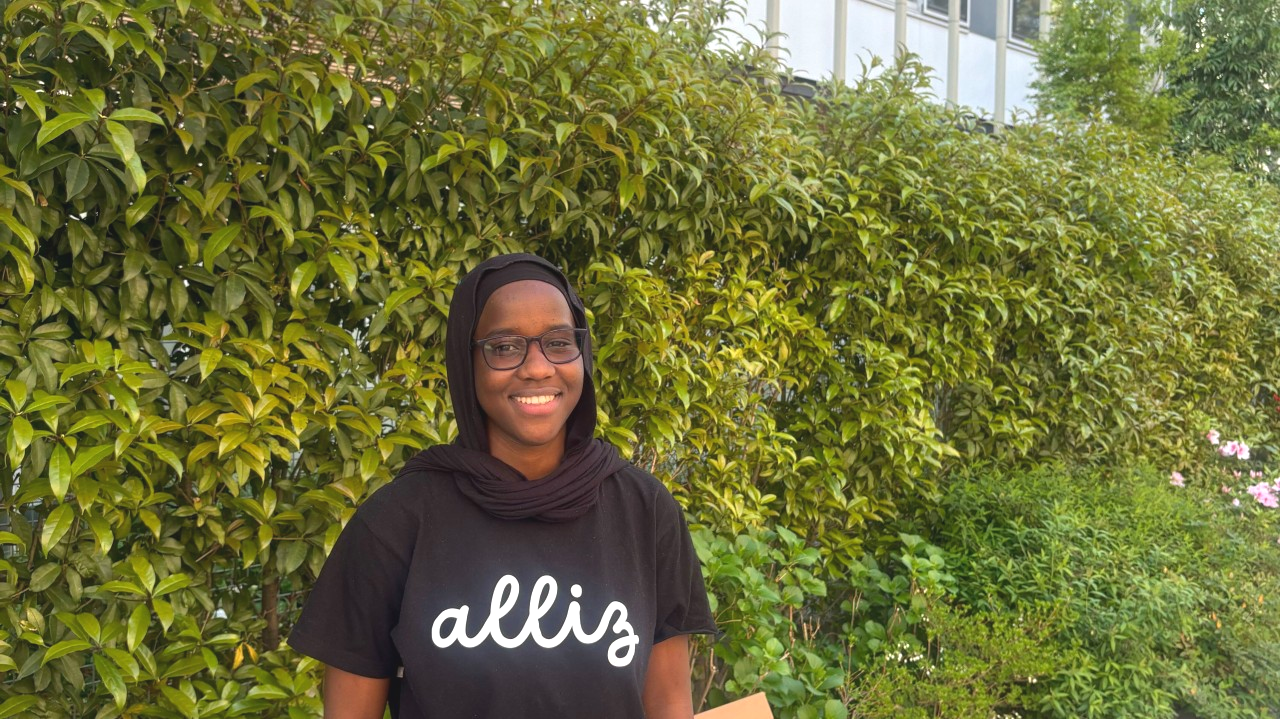
For this community interview, we learn from Aisha Kyobe, majoring in Computer Science at Temple University, Japan Campus. She recounts her journey at alliz throughout the spring of 2026, growing from an enthusiastic computer science student to a versatile and seasoned full-stack engineer.
Tell me, and I forget: choosing what speaks louder
After applying for positions at a handful of organizations in her university’s internship directory, Aisha managed to receive two offers, one of which was from alliz.
Thus, it was time to decide.
“The other company was marketing search engine optimization, it was an AI startup. But when you search their name in Google, you wouldn’t even see it as the first thing that comes up. That’s very important in search engine optimization.”
When she puts it this clearly, it seems almost obvious. If you want to learn how to do something, and you must learn from others, you’d rather learn from those who are doing it well.
Of course.
But this knowledge is not to be taken for granted; it requires properly identifying your targets, breaking them down into measurable goals, and understanding how to gauge those metrics in others.. In the case of Aisha, she sought the effective application of digital tools, and found a straightforward method to get an answer.
“On the other hand, when I did [look up] alliz, it was the first one that came up,” she recounts.
In the end, even though another organization might be more specialized on paper, hard results came out on top, and Aisha made her decision.
Teach me, and I remember: not everyone’s an expert
“It was my very first internship.” After getting the notice from Congqin, the founder, that she’d begin her internship at alliz, she recounts being quite nervous. On speaking to her career advisor, she was also told that while other companies care more about the output produced, alliz had a stronger focus on actually developing the skills of their interns. A great challenge might be brewing ahead.
“What I really liked at the beginning is that they gave us eight days of onboarding.”
The internship at alliz commenced under the tutelage of Gustavo, tech lead of alliz and star of a previous community interview. As the weeks progressed, Aisha would expand her skillset well beyond what was covered during the propaedeutics, but she recognizes this stage as essential. “Because, you know, it is very different from just studying in the class, or coding for an exam. It was really nice that [Gustavo] used to take his time to teach us what was what in the code base.”
However, as Xunzi (and Benjamin Franklin) could tell you, teaching is not the same as telling. Knowledge in a single direction travels inward through the ears and downwards into oblivion.
What makes the difference, then?
“He would give you a hint and tell you, we use this tool for this reason. Go and search more about it, and at the end of the day, bring me a deliverable that shows you have understood.”
It’s not about completing deliverables. Aisha was encouraged to make discoveries in her area of work. This provides an organic pathway to further increase her knowledge. For someone who is just starting out, this call to curiosity may well be the initial spark that fuels a journey of consistent progress.
A well-rounded training pays off in the long term. Aisha was primarily tasked with the functions of a front-end developer, but while conducting day-to-day operations, the needs of the project required her to expand her skillset. “Since it’s a startup, I’ve also been able to work on some back-end issues. You know, it’s very flexible. I could talk to Gustavo about particular issues I was interested in.” The frameworks used in the website included some that Aisha had never used before. “The whole language I’m programming in at alliz, I have learnt at alliz.”
Involve me, and I learn: building systems of knowledge
Aisha discovered another crucial difference of working for a full team, namely, one that is not exclusively composed of programmers. “We have to deliver weekly updates, and at first I wouldn’t really think of the people who are going to receive this information through the joint channels. I’d write these very technical explanations of my process, and forget that some of the people reading them are not necessarily familiar with these terms.”
It was her turn to teach.
Communicating with a team, unsurprisingly, is also a team endeavor. The receiving end brings their attention and their willingness to understand, but the giving end must also consider the kind of audience they are presenting to. Some processes might require a conceptual break-down, while some others are better summarized in a sentence or two. “You’re not always going to just be coding. You’re going to have to talk to your boss and you’re going to have to communicate with the clients, as well.”
Another important difference was the goal-setting. “Congqin is very mentorship-focused. She made us set these goals: what do you want to get out of this internship?” Therein laid the other important difference from goal-setting in an academic context. “Usually, when they ask me questions like that, I just write a bunch of stuff that I never do, that I never follow up on. But for this goal-setting, I was asked to make objectives that I could achieve in a week, in two, or in a month. She told me, ‘once the deadline is met, we’re going to look back at this and evaluate whether you have actually achieved this’.
For her, keeping track was key. Once the rhythm of regular work settles in, it is easy to get lost in the issues that appear in more immediate timeframes.
Meeting these goals, she found, was not as straightforward a process as it might have seemed at the beginning. In resolving a particular issue, a problem might be solved in paper, but the solution itself is not conducive to more progress. “The other week I had to add graduation labels on the member’s profiles if they were to graduate in 2026. That took me like two weeks.” “The other thing about working in a company space is that you can make a solution that’s just easy for now, but it won’t be sustainable for the future. If this was an exam or a homework, I would have gotten 100%, because it was showing exactly what’s supposed to be there. But I had to think about future developers, like interns who are going to come after me. How can I make their work faster? That led to a whole change of the code base, like opening a rabbit hole.”
At last, the progression was complete.
She had familiarized herself with the structures as a beginner, engaged the tools for the task in a practical setting, and contributed to further development by extending her knowledge towards a new direction, one that others could follow her in.
By getting told, getting taught, and most importantly getting involved, Aisha turned from an aspiring web developer to a fully-fledged professional.
One who can not only do as they are told, but continue to foster growth well beyond her own person.
In the end, Aisha changed from needing a mentor herself to becoming a teaching figure for others along the line.
“At some point, I’m going to have to look at the code that other people made, people who came before me. I’m going to have to update what they had, and at the same time think of what future me, or future anyone else, will find.”
As her internship comes to a close, her contributions extend beyond Computer Science. Her insights are built to promote further growth, ready to help the next generation of learners.
And so, Aisha sows the seeds for the cycle of learning to start anew.